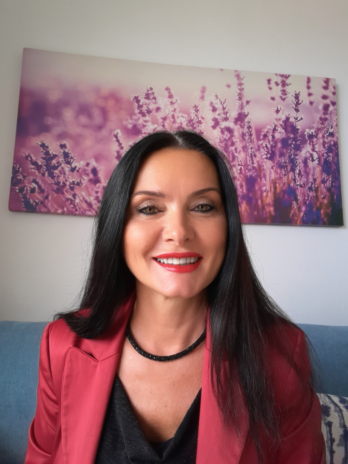
Klaudia Fliegelova (Slovakia/Italy)
Born in Trnava, a city of the size as Oostende, populated since Neolithic times with a mix of Slovak, Hungarian, German and Jews (and even descendants of Walloons) at a cross road of cultures with the 17th century first Hungarian university and a local dialect which served as standard codification of Slovak and with the first Hungarian horse-drawn railway.
A year after her birth, her father abandoned her and her mother and then kidnapped her when she was two years old. After six months, the police discovered her in Hungary and she was brought back to her mother: fearing another attack of her Ex, after the divorce, the mother fled from Czechoslovakia to Este in the Italian region of Veneto.
The father devoted himself entirely to his political career and became the right hand of the Slovak Foreign Affairs Minister and was assassinated.
Living in absolute poverty, she dreamed of a future career to help others as a medical doctor and was a permanent visitor in the local library to read and to read …
To sustain their life, she and her mother had to work in the local vineyard, in shops and as babysitter. Despite excellent results in college, lack of finance had closed the door to university. Instead, she followed an education as naturopath. Developing a more holistic approach, she added as well courses in emotional awareness and management. She became more and more aware that emotions play a key role in well-being and health and concentrated on personal development – understanding that self-learning will give you the ability to help others on their personal journey.
After marrying and becoming a mother (her daughter is now living between Hong Kong and Paris), she co-founded an NGO focussing on the development of the personality and became President of a training centre on nutrition – especially for children – and to heal personal trauma through the processing of the family history. When these Veneto-based structures moved away from a value-based orientation to a more business one, she left.
Being 50 years old – what to do?
She enrolled in psychology at the University of Turin, passed her examines during Covid and (her daughter has just left the family home) moved to the Canary Islands and to Portugal to continue her studies on-line and to contemplate on her future. Being – by age – the most senior participant of an Erasmus+ project, she found finally an answer what to do.
She founded Emozionologia® and created the website and platform (www.emozionologia.it) to offer courses on emotional awareness and management and created in Italy the roots of a new profession category “emozionologist”. Her innovative training programs such as Emotional Efficiency at Work and Interpersonal Skills and Sensitive Mediation, have been included in the work of human resources in the European Parliament. Through her work, she combines education, research, and human sensitivity, building an emotional community that promotes health, values, and sustainable development for a more conscious and inclusive future.
She receives this award for her permanent resilience to stand up after so many challenges, to create structures focussing on personal development and healing of trauma – and to show that a woman in her 50s can still start – and finish – her university studies.