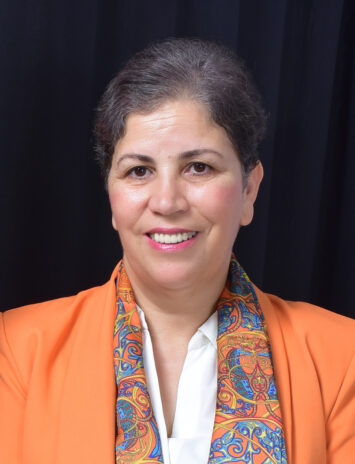
Khadija Bendam (Morocco)
Her commitment to knowledge sharing and to inclusion inspired her to two key roles:
Born in Sidi Slimane, this Moroccan city surrounded by plains and oranges trees, Khadija Bendam grew up in a family that valued education, integrity, and perseverance. From a young age, she was fascinated by the mysteries of science and the invisible forces shaping the universe, an early curiosity that would one day lead her to the heart of the nuclear field.
Her academic journey began in Rabat at the École Mohammedia d’Ingénieurs, where she specialised in environmental engineering. Determined to explore the interface between technology and safety, she pursued postgraduate studies in radioprotection and radiation source safety, followed by a higher postgraduate diploma in nuclear physics from Mohammed V University. This blend of scientific rigour and public service marked the beginning of a career devoted to protecting people and the environment.
As head of nuclear and radiological safety at Morocco’s leading nuclear institution, she played a central role in strengthening nuclear security infrastructure and having contributed to the role of her country as a regional model in nuclear governance.
Her expertise transcends borders. Recognised by the International Atomic Energy Agency, the IAEA, as an expert in emergency preparedness and response, safety, security, and public communication, she has participated in numerous international missions and capacity-building programs. She was even nominated as the focal point of her country for special medical emergencies of the UN health agency, the WHO.
On the African level she was in charge of leading the first two field nuclear security exercises: in Botswana for the English speaking and in Senegal for the French speaking countries. On the global level, she was part of the authors of two key publications of the International Atomic Energy Agency: one on communication on emergency and preparation, the other on the préparation and evaluation of exercises to test emergency preparedness
Her commitment to knowledge sharing and to inclusion inspired her to two key roles:
One, to create and chair, the global platform connecting women professionals “Women in Nuclear in Emergency Preparedness and Response Initiative”, under Women In Nuclear Global an organisation with 80 000 members in 47 countries on national, continental and global level, with – among others – the aim to inspire the next generation of nuclear professionals,
Two, to become Vice President of the Arab Women’s Network advocating for the integration of women’s perspectives and fostering regional solidarity in addressing chemical, biological, radiological, and nuclear challenges.
This leadership has resulted in numerous distinctions among them “Woman of the Year in Nuclear”, the “Iconic African Leader 2024” and her induction into the African Leaders Hall of Fame by „The New Africa Magazine“. The UN cultural agency, UNESCO, highlighted her on International Women’s Day as one of the inspiring women of the world.
Her growing international influence has led to invitations to the world’s most prominent platforms, including the US Institute of Nuclear Materials Management Conference.
In September this year, she received the highest honour in this male-dominated sector: she became the first woman to be nominated President of the International Nuclear Societies Council during the 69th General Conference of the International Atomic Energy Agency in Vienna..
Guided by integrity, scientific excellence, and a sense of duty, she embodies the commitment to safety, innovation, and sustainable progress. Her journey, from a curious girl in Sidi Slimane to an international authority in nuclear security, reflects the power of knowledge, resilience, and vision to contribute to a better world where women play a key role.
Guided by integrity, scientific excellence, and a sense of duty, she embodies the commitment to safety, innovation, and sustainable progress. Her journey, from a curious girl in Sidi Slimane to an international authority in nuclear security, reflects the power of knowledge, resilience, and vision to contribute to a better world where women play a key role.